CRM Implementation Playbook 2025
CRM implementation succeeds when you pick the platform by business motion, Customer.io for product-led, Klaviyo for e-commerce, HubSpot for sales-led, and follow a deliverability-first rollout: data governance, IP warming, lifecycle flows, and team adoption across seven phases, not a rushed tool switch.
Use the CRM Implementation Checklist 2026 for a step-by-step rollout, or see CRM Implementation Services for hands-on help.
Customer.io - Klaviyo - HubSpot
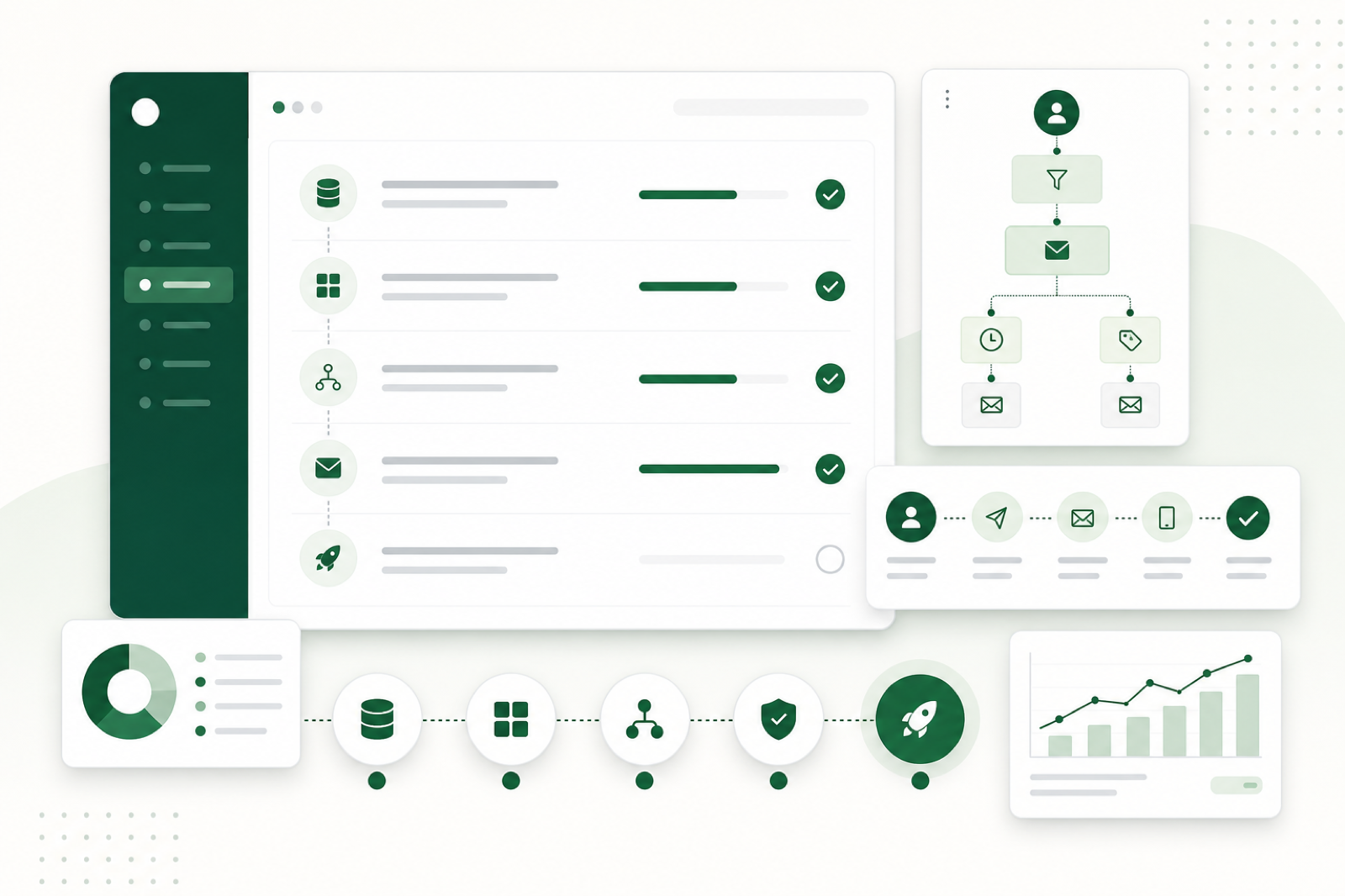
Most CRM projects stall. Not because the tool is wrong. But because data, deliverability and adoption are afterthoughts. This playbook guides you through implementing Customer.io, Klaviyo or HubSpot. With a deliverability-first, data-led approach. Connecting acquisition, activation and retention.
What you get:
- A 7-phase rollout framework that cuts risk and accelerates value.
- A platform selection lens that maps business motion to the right tool.
- A ready-to-use IP warming plan that protects domain reputation.
- Governance, templates and a KPI set that prove ROI fast.
Quick mapping
- Customer.io - best for B2C SaaS and product-led growth with event-driven messaging.
- Klaviyo - best for e-commerce revenue flows and SMS pairing.
- HubSpot - best for B2B SaaS with sales-marketing-service alignment. Also viable for hybrid B2C/B2B motions with recent e-commerce hub expansions.
Practical CRM checklist
If you want a short, operational version of this playbook, use the CRM Implementation Checklist 2026 as a quick implementation guide.
Need clear definitions for implementation terms like incrementality, ETL, suppression lists, and domain warming? See the resources hub for related playbooks and checklists.
Table of Contents
What is CRM Implementation - and Why It Fails Without Strategy
Definition
CRM implementation connects data, builds journeys and trains teams to run measurable lifecycle programs across channels. The output is predictable acquisition, activation and retention.
Why most projects fail
- No unified data model - duplicate contacts, orphaned companies, mismatched IDs.
- Weak governance and over-customization - anyone can add fields with no naming rules or owners, creating hundreds of unused fields and workflows.
- Ignoring deliverability - new domain or volume spike without IP warming leads to throttling and spam placement.
- No success criteria - teams cannot tell if it worked beyond "emails were sent".
What good looks like
- Clear KPIs tied to business goals (activation, recovery, SQL rate, repeat purchase).
- Phased plan with owners and success gates.
- Modular templates and journeys.
- Deliverability monitoring (daily during ramp, weekly after).
- Role-based training with actionable dashboards.
Connect CRM to revenue
Quantify value with the CLV calculator.
Forecast payback on setup and migration with the CAC payback tool.
Choosing Customer.io vs Klaviyo vs HubSpot
Use the business motion-first rule
Match platform to growth motion and data behavior.
Fit summary table
| Platform | Ideal for | Core strength | Time-to-value | Typical services cost |
|---|---|---|---|---|
| Customer.io | B2C SaaS, product-led | Event-driven journeys across email-push-in-app-SMS | 4-8 weeks | €15k-50k |
| Klaviyo | E-commerce brands | Store-native flows, predictive CLV, SMS | 2-4 weeks | €8k-25k |
| HubSpot | B2B SaaS | Unified CRM and revenue ops, attribution | 6-12 weeks | €25k-100k |
Note: Estimated costs based on typical EU project scopes.
Key considerations
Data model
- Customer.io - people and events (identify/track).
- Klaviyo - commerce objects (customers, orders, items).
- HubSpot - objects and relationships (contacts, companies, deals, tickets).
Integrations
- Native connectors and webhooks vs custom pipelines.
- Authentication model, rate limits, and retries.
Team ownership
- Marketing ops and product data lead for Customer.io.
- E-commerce manager and merchandising for Klaviyo.
- Sales ops and marketing ops for HubSpot.
Change cost
Field sprawl and legacy automations are the silent budget killer. Clean first.
When to replatform
- License or CPM creep.
- Need for event-level personalization or pipeline governance.
- Deliverability debt requiring subdomain reset.
Need Help Choosing the Right CRM?
Get a free CRM platform assessment tailored to your business needs. I'll analyze your requirements, team size, and growth stage to recommend the perfect CRM solution.
CRM Platform Comparison: Customer.io vs Klaviyo vs HubSpot vs Salesforce
With four major CRM platforms competing for market share, understanding their differences is crucial before committing significant budget and resources. This comparison evaluates Customer.io, Klaviyo, HubSpot, and Salesforce across key criteria: ideal use case, core strengths, pricing, and implementation complexity. Each platform serves distinct business models-Customer.io excels in product-led SaaS with event-driven journeys, Klaviyo dominates e-commerce with predictive segmentation, HubSpot offers unified B2B revenue operations, and Salesforce provides enterprise-grade customization at scale.
My comparison methodology analyzes five dimensions: fit (business model alignment), technical (data model and integrations), financial (total cost of ownership over 24 months), operational (team training curve), and strategic (scalability and vendor risk). The goal is not to declare a "winner" but to match platform capabilities to your growth stage, team maturity, and data architecture.
| Platform | Best For | Strengths | Pricing Range |
|---|---|---|---|
| Customer.io | B2C SaaS, product-led companies | Event-driven messaging across email, push, in-app, SMS. Strong segmentation based on behavioral data. Developer-friendly API. | €15k-50k (setup + first year) |
| Klaviyo | E-commerce, D2C brands | Predictive CLV scoring, store-native integrations, strong flows for abandoned carts and post-purchase sequences. | €8k-25k (setup + first year) |
| HubSpot | B2B SaaS, sales-marketing alignment | Unified CRM with marketing, sales, service hubs. Strong attribution reporting. Excellent for multi-touch attribution. | €25k-100k (setup + first year) |
| Salesforce | Enterprise B2B, complex sales cycles | Maximum customization, robust sales forecasting, advanced reporting and analytics. Industry-leading partner ecosystem. | €50k-500k+ (setup + first year) |
HubSpot vs Customer.io: Detailed Breakdown
For B2B SaaS teams evaluating HubSpot vs Customer.io, the choice hinges on whether you prioritize unified sales-marketing ops (HubSpot) or product-led growth with behavioral triggers (Customer.io). HubSpot excels when sales cycles involve multiple touchpoints, MQL-to-SQL conversion tracking, and deal pipeline management. Customer.io wins when activation, feature adoption, and retention are your core metrics.
| Criteria | HubSpot | Customer.io |
|---|---|---|
| Data Model | Contacts, Companies, Deals, Tickets (relational) | People and Events (non-relational, behavior-driven) |
| Use Case | B2B sales pipeline, multi-touch attribution, account-based marketing | Product activation, feature onboarding, behavior-triggered retention |
| Integration Complexity | High (500+ native integrations, but complex mapping) | Medium (requires API work, but flexible data flow) |
| Personalization | Static segments, list-based campaigns | Real-time event triggers, dynamic segments |
| Cost for 10k Contacts | €800-1,500/month (Professional) | €150-400/month (based on sends) |
| Time-to-Value | 6-12 weeks (complex setup, training required) | 4-8 weeks (developer-friendly, faster to implement) |
| Pros | Excellent attribution reporting, sales-marketing alignment, mature marketplace | Event-driven automation, flexible segmentation, cost-effective at scale |
| Cons | Expensive, steep learning curve, complex governance | Limited reporting out-of-the-box, requires technical skills, B2B features weaker |
Decision Rule: Choose HubSpot if your primary growth metric is revenue (deals, SQLs, pipeline velocity). Choose Customer.io if activation, retention, and feature adoption drive your business model. For B2C SaaS with a sales layer, consider HubSpot Marketing Hub paired with Customer.io for product-led campaigns.
The 7-Phase CRM Implementation Framework
Low-risk rollouts are phased with clear goals, owners and exit criteria. Expect 14-26 weeks.
Framework overview
| Phase | Duration | Goal | Exit criteria |
|---|---|---|---|
| 1. Foundation and discovery | 1-2 weeks | Align on outcomes and scope | Charter approved, KPI map signed |
| 2. Data strategy and governance | 3-4 weeks | Define model, clean data | Data dictionary, mapping spec, dedupe done |
| 3. Integrations and technical setup | 5-8 weeks | Connect systems and authenticate | APIs live, SPF-DKIM-DMARC passing |
| 4. Content and workflows | 9-12 weeks | Build modular templates and journeys | Onboarding, recovery, reactivation live in staging |
| 5. QA and testing | 13-14 weeks | Validate content, logic and inboxing | Seed tests green, MXToolbox clean, UAT signed |
| 6. Rollout and IP warming | 15-18 weeks | Ramp safely, protect reputation | Volume stepped, benchmarks within targets |
| 7. Optimization and training | 19-20 weeks | Enable adoption and measure ROI | Dashboards live, training delivered, first win logged |
Phase details
Phase 1 - Foundation and discovery
- Objectives: define business goals, non-goals and scope boundaries.
- Workshops: lifecycle map, attribution, consent, reporting.
- Outputs: project charter, responsibility matrix, KPI framework and risk register.
- Success gate: sponsor sign-off and clear out-of-scope list.
Phase 2 - Data strategy and governance
- Inventory sources: CRM, product events, commerce, billing, support, analytics.
- Map keys and relationships: user_id, account_id, order_id, deal_id.
- Governance: field naming, owners, creation policy, deletion policy, audit cadence.
- Outputs: data dictionary, mapping spec, deduped golden records.
- Success gate: test import shows stable relationships and no duplicates.
Phase 3 - Integrations and technical setup
- APIs and webhooks with retry logic and dead-letter handling.
- Email authentication: SPF and DKIM aligned, DMARC set to monitor then tightened.
- Tracking domains and subdomain strategy for sending and click tracking.
- Outputs: integration map, monitoring alerts, error runbooks.
- Success gate: all integrations pass health checks for 7 days.
Phase 4 - Content and workflows
- Templates: modular blocks, responsive, accessible, brand-safe.
- Personalization: Liquid or conditional blocks with safe fallbacks.
- Journeys: onboarding, activation nudges, cart and browse recovery, win-back, VIP.
- Outputs: content library, frequency caps, suppression rules.
- Success gate: staging sends render correctly across clients.
Phase 5 - QA and testing
- Unit tests: every trigger, branch and fallback.
- Deliverability: MXToolbox DNS check, seedlist inbox placement, soft launch to engaged cohort.
- UAT: role-based acceptance with real scenarios.
- Success gate: seed results acceptable and UAT sign-off.
Phase 6 - Rollout and IP warming
- Canary cohorts: start with most engaged recipients.
- Daily checks: complaints, bounces, opens by ISP.
- Weekly step-up: controlled volume increase per schedule.
- Success gate: stable metrics and positive domain reputation.
Phase 7 - Optimization and training
- Dashboards: adoption, deliverability and revenue KPIs.
- Training: role-based sessions and playbooks.
- Iterations: prune low-value flows, expand high-value segments, test send time.
- Success gate: first measurable business win and usage targets met.
🚀 Ready to Implement?
See my CRM Implementation Services - I'll handle the entire implementation from platform selection to team training, including data governance, IP warming, and adoption strategies.
Deliverability and IP Warming
When IP warming is required
- New domain or subdomain for sending.
- CRM migration or big ESP change.
- Reactivation after 60+ days inactivity.
- Significant volume increase or list import.
Benchmarks to stay inside
| Metric | Target |
|---|---|
| Spam complaints | Under 0.1% |
| Unsubscribes | Under 1% |
| Bounce rate | Under 2% |
| Open rate | Above 25% on engaged cohorts |
Progressive warm schedule - example
| Day range | Daily volume target | Expected opens | Focus checks |
|---|---|---|---|
| 1-3 | 500 | 40% | Hard bounces, complaints |
| 4-7 | 5,000 | 35% | Soft bounce pattern, throttling |
| 8-14 | 25,000 | 30% | Engagement by ISP |
| 15-21 | 100,000 | 25% | Reputation trend |
| 22+ | Steady state | Stable | Expand audiences cautiously |
Note: Adjust volume based on list size and engagement; consult Google Postmaster data for high-volume senders (e.g., 1M+ lists).
Safety controls
- Prioritize recent engagers with consistent cadence.
- Isolate risky segments to separate subdomain.
- Monitor Google Postmaster daily during ramp.
Tool stack
Google Postmaster Tools, MXToolbox (DNS/blacklists), DMARC monitor, seedlist testing.
Internal tool: IP warm-up planner.
Data and Governance Best Practices
Data quality pillars
- Completeness - required fields present and validated.
- Consistency - naming conventions, allowed values, normalized enums.
- Accuracy - dedupe, merge rules, email and phone validation.
- Governance - field owners, change log, quarterly cleanup.
Field naming approach
- Prefix by domain (mkt_, prod_, sales_) with lowercase and underscores.
- Use ISO codes for countries, currencies and languages.
- Minimize free text fields.
Event schema example - Customer.io
| Event | Attributes | Triggered when | Drives |
|---|---|---|---|
| signup | user_id, plan, source | Account created | Welcome sequence |
| activation | feature_name, ts | First key action done | Activation nudges |
| upgrade | new_tier, value | Plan upgraded | Upsell and onboarding |
| churn_risk | score, reason | Risk threshold crossed | Save and re-engage |
Consent and identity
- Map consent by channel and purpose with lawful basis.
- Honor quiet hours for SMS.
- Define identity rules to join events, people and companies.
Need a Data Governance Plan?
Get a free data governance plan tailored to your CRM implementation. I'll help you map consent by channel, define identity rules, and ensure GDPR compliance.
Automation, Workflows and Personalization
Build flows that move revenue, not volume
- Onboarding - first value fast, one job per message.
- Activation - next feature based on behavior.
- Recovery - cart and browse flows with value-first incentives.
- Retention - engagement scoring, reactivation, win-back.
- Expansion - upgrade triggers and milestone nudges.
By platform
Customer.io
- Event-driven, cross-channel.
- Great for product signals and in-app + push.
- Use Liquid with strict fallbacks to avoid nulls.
Klaviyo
- Cart, browse, post-purchase, replenishment, VIP, review request.
- SMS pairing with smart frequency caps.
- Predictive CLV for VIP tiers and next-order timing.
HubSpot
- MQL to SQL handoff with SLA alerts.
- Sequences for follow-up and meeting booking.
- Renewal and expansion workflows tied to deals.
Personalization rules
- Use if-else blocks sparingly with safe fallbacks.
- Centralize dynamic snippets for single-source editing.
- Cap frequency across channels with shared suppressor.
Compliance
- Visible unsubscribe and preference center.
- Clear sender identity with physical address.
- Global suppression across journeys.
Internal link: Balance CRM and paid budgets with the mix allocator.
Testing, Monitoring and Optimization
Pre-launch QA checklist
- Unit tests for triggers and delays.
- Rendering tests on common clients and devices.
- Link checker, UTM checker and fallback content audit.
- MXToolbox for SPF-DKIM-DMARC status.
- Seed tests with Litmus or similar.
- Dry-run to engaged canary cohort.
Post-launch dashboard
| KPI | Excellent | Warning | Action |
|---|---|---|---|
| Spam complaints | Under 0.1% | Over 0.2% | Pause sends for that ISP, review content |
| Unsubscribes | Under 1% | Over 2% | Check audience and value proposition |
| Bounce rate | Under 2% | Over 5% | Verify DNS, prune invalids |
| Open rate | Over 25% | Under 15% | Test subject and sender, check placement |
| Click rate | Over 2% | Under 0.8% | Improve offer and CTAs |
| Conversion rate | Lift vs baseline | Flat | Improve relevance and sequence timing |
Iteration plan
- Weekly: fix defects, prune low performers.
- Bi-weekly: new tests - subject, send time, segment.
- Monthly: review reputation, expand audiences.
- Quarterly: governance audit and template refresh.
Need a Deliverability Health Check?
Request a free deliverability health check to identify and fix email delivery issues. I'll analyze your domain reputation, authentication setup, and provide actionable recommendations.
Adoption, Training and Change Management
CRM works when people use it. Treat adoption as its own product.
Change levers
- Explain "why" in one page with cost of current gaps.
- Name champions per team (marketing, sales, success, data).
- Train by role with 10 daily tasks.
- Remove competing tools.
- Pin dashboards as default browser tab.
Usage metrics to track
- Login frequency by role.
- Records created and updated per user.
- Sequence enrollment and completion.
- SLA adherence on MQL to SQL.
- Flow coverage and customer reach.
Operating rhythm
- Daily standup (first 2 weeks hypercare).
- Weekly usage and deliverability review.
- Monthly business review (wins, issues, next bets).
Internal link: Tie adoption to outcomes with the performance strategy page.
Continuous Improvement and Future Trends
The CRM is never "done"
Stack evolves with privacy rules, channel fatigue and product roadmap.
Trends to watch
- AI-assisted content blocks and send-time optimization.
- Predictive churn and next-best-action in journeys.
- Server-side tracking and consent-driven data layers.
- Audience sync from CRM to ad platforms with better incrementality testing.
- Multi-domain reputation strategy for high-volume senders.
Quarterly improvement loop
- Analyze KPI shifts and attribution.
- Remove obsolete fields and workflows.
- Add 1-2 high-ROI journeys, not 10.
- Refresh templates and run an accessibility (A11y) pass.
- Review vendor roadmap - adopt only what changes outcomes.
Ready for CRM Readiness Audit?
Book a free funnel fix call to assess your CRM readiness. I'll evaluate your current setup, identify bottlenecks, and create a roadmap for successful CRM implementation.
FAQ
How long does CRM implementation take?
Typical is 3-6 months. The driver is data cleanup and integrations, not email templates.
Which CRM is best for a SaaS startup?
Customer.io if you need event-driven messaging. HubSpot if pipeline governance and sales visibility dominate.
Do we always need IP warming?
If the domain, subdomain or volume is new - yes. Skipping it risks throttling and poor inbox placement.
How do we measure success post-implementation?
Adoption metrics, deliverability KPIs, and revenue KPIs per journey (trial activation, cart recovery, SQL rate, repeat purchase, renewal).
What are realistic early wins?
- Welcome and onboarding clarity that lifts trial-to-activation.
- Cart and browse recovery revenue.
- Faster MQL to SQL speed with SLA alerts in HubSpot.
What breaks most often during migration?
Field mappings, identity joins, and legacy automations. Fix with a test import, a data contract and ruthless field governance.
Related: CRM checklist · CRM cost guide · CRM service
Author

Published: October 2025
Last updated: October 11, 2025
If you prefer to have an experienced operator handle the implementation, you can work with me as a Customer.io Certified Partner. I can take this framework and apply it to your Customer.io setup end to end.
Helpful resources
Ready to Implement Your CRM?
Book a free strategy call to discuss your CRM implementation strategy and see how I can help.
Book a 30-minute Free Strategy Call
Use this short call to discuss your CRM challenges, review your current setup, and explore implementation opportunities.