ChatGPT Ads 2026: Growth Strategy Guide

OpenAI is building an ad business. Here's what it means for your acquisition strategy.

ChatGPT is becoming a new intent layer between Google Search, Meta feeds, and Amazon retail media. This changes how people discover and choose products.

TL;DR: OpenAI is launching ads on ChatGPT in 2026. Code reveals production-grade ad infrastructure. It will use semantic intent matching, not keywords. This creates a high-intent performance channel that requires different strategy than Google or Meta. Prepare by mapping AI intent, fixing measurement, and optimizing for AEO.

Key Takeaways:

  • Production-grade ad infrastructure already exists in ChatGPT Android builds
  • Semantic intent matching replaces keyword targeting—ads match conversation context
  • New high-intent performance channel requiring different strategy than Google/Meta
  • Will punish weak positioning, sloppy measurement, and poor AEO
  • Prepare by mapping AI intent, fixing measurement infrastructure, and optimizing for answer engines
ChatGPT advertising infrastructure code evidence showing ad components

Introduction

ChatGPT is about to get ads.

What started as a chat interface is turning into something closer to Google, Meta, and Amazon combined: a place where people search, compare, plan, and buy inside one AI-driven conversation.

Over the last months, the direction became clear: ad-related code in the Android app, new product surfaces like Pulse and Atlas, in-chat shopping, and a wave of senior hires from Meta and Google. Together, this points to one thing: OpenAI is building an ad business on top of ChatGPT.

If you run growth, marketing, or product, this isn't "just another channel launch." It's a new intent layer that sits between Google Search, Meta feeds, and Amazon retail media. It will change how people discover and choose products.

Here's what's happening, why it's happening, how it will likely look, and what it means for your acquisition, measurement, and Answer Engine Optimization (AEO).

TLDR

  • Recent ChatGPT Android builds contain a full ad stack: components for search ads, carousels, ranking weights, and dismiss events, not just a test flag.
  • The macro environment is forcing OpenAI toward ads: high rates, massive compute costs, investor pressure, and a huge free user base that must be monetized.
  • OpenAI has already shipped the surfaces you need for ads: a personalized feed (Pulse), its own browser (Atlas), and instant checkout inside ChatGPT.
  • Compared to Google, Meta, and Amazon, ChatGPT will trade in multi-step intent and recommendations, not single clicks or isolated impressions.
  • For teams, this becomes a high-intent, high-trust performance channel that will punish weak positioning, sloppy measurement, and bad AEO.

What Changed

Over the last months, several signals aligned.

Code-Level Evidence

Developers decompiling ChatGPT Android beta builds found explicit ad components:

  • SearchAd and SearchAdsCarousel
  • BazaarContentWrapper for commerce content
  • ad_ranker_weight, inference_contextual_weights, bazaar_content_relevance
  • ad_dismiss_event for interaction tracking

This looks like production-grade plumbing: ranking, relevance scoring, impression counters, and events. You don't build this just to see how it feels.

OpenAI wordmark
OpenAI is building an advertising infrastructure that will transform ChatGPT into a new performance marketing channel.

A handful of Pro users have already reported "this looks like an ad" moments inside normal chats—for example, a Peloton promo surfacing inside an unrelated thread (source).

The Supporting Product Surfaces

In parallel, OpenAI shipped exactly the kind of surfaces you need to host ads:

  • ChatGPT Pulse: A personalized daily feed of content cards based on your chats and connected apps. It already looks like an ad-ready home screen.
  • ChatGPT Atlas Browser: A native browser with ChatGPT running alongside your browsing session. It creates ad real estate across the whole web journey, not just inside chat.
  • Instant checkout in chat: You can already buy products from Etsy and a growing number of Shopify merchants without leaving the conversation. OpenAI calls results "organic and unsponsored" today, but the commerce rails are in place.

Hiring, Projections, and Public Statements

On top of this, you have:

  • OpenAI hiring hundreds of ex-Meta people, including senior leaders with deep ads and app monetization experience.
  • Public revenue projections that explicitly include "free user monetization" reaching around $1B in 2026 and $25B in ad revenue by 2029 (source).
  • Sam Altman's shift from calling ads "dystopian" to "there is probably some cool ad product that is a net win for the user" (source).

Takeaway: Taken together, this isn't a rumor. It's a roadmap.

The Macro Picture: Why Ads Are Inevitable

Zoom out from product details and look at the economics.

Running Frontier Models Is Expensive

Training and inference for models at ChatGPT scale require massive amounts of compute and energy. That cost goes up with every user and every token. You can't hide it forever behind investor cash.

The User Mix Is Skewed Toward Free

Rough ballpark numbers from various reports:

  • ~800M weekly active users
  • Only 4 to 5 percent convert to a paid plan
  • That leaves hundreds of millions of people generating zero direct revenue while burning real GPU time

The Capital Cycle Has Flipped

The zero interest rate world where "growth at all costs" was enough is gone. Investors now want to see:

  • Enterprise and API revenue
  • Consumer subscriptions
  • High-margin ad revenue that can scale with user base

We've seen this pattern before:

  • Google went from a clean search box to AdWords and AdSense and now funds everything from YouTube to Waymo with that cash.
  • Meta turned social feeds into a direct response machine that drives performance budgets globally.
  • Amazon realized that being the start of product search is itself ad inventory and built a massive retail media business on top.

Takeaway: OpenAI is entering the same phase: big reach, big fixed costs, impatient capital, and a product that captures intent. Ads are the most obvious way to close that loop.

How ChatGPT Ads Differ from Google, Meta, and Amazon

Treating this as "Google Ads in a chat window" is the wrong model.

Google Search vs ChatGPT

Google: Short query, static results page, ad slots around links.

ChatGPT: Ongoing conversation with clarifications, examples, and follow-ups.

On Google, you buy against keywords and audiences. In ChatGPT, you'll buy against evolving intent inside a dialogue.

You're not bidding on "CRM software" in isolation. You're stepping into a thread where someone says: "Given my current stack and budget, how do I migrate off tool X without breaking reporting or changing my data model?"

That's closer to sponsoring a consult than buying a click.

Meta Feeds vs ChatGPT

Meta: Users are in "scroll" mode. Ads are visual and interruptive, tuned to interest and identity.

ChatGPT: Users are in "solve" mode. They're trying to get a decision, plan, analysis, or asset over the line.

Meta manufactures or amplifies desire. ChatGPT captures declared problems and tasks in the user's own words. Supporting that with sponsored suggestions will require a different creative and measurement mindset than your current feed ads.

Amazon Retail Media vs ChatGPT

Amazon: You're already inside a catalog and ready to buy. Ads boost certain SKUs.

ChatGPT: You might be buying, but you might also be designing a process, comparing vendors, writing code, or planning a renovation.

Amazon is mostly bottom of funnel. ChatGPT spans the entire funnel in one thread:

  • "What should I do?"
  • "What are my options?"
  • "What's the trade-off between A and B?"
  • "Help me implement this in my stack."
  • "Send the email, update the sheet, buy the thing."

That makes the ad inventory powerful but also sensitive. You're not just shifting share between two products; you're influencing how people frame whole categories and workflows.

Takeaway: ChatGPT ads will trade in multi-step intent and recommendations, not single clicks or isolated impressions.

Likely ChatGPT Ad Formats

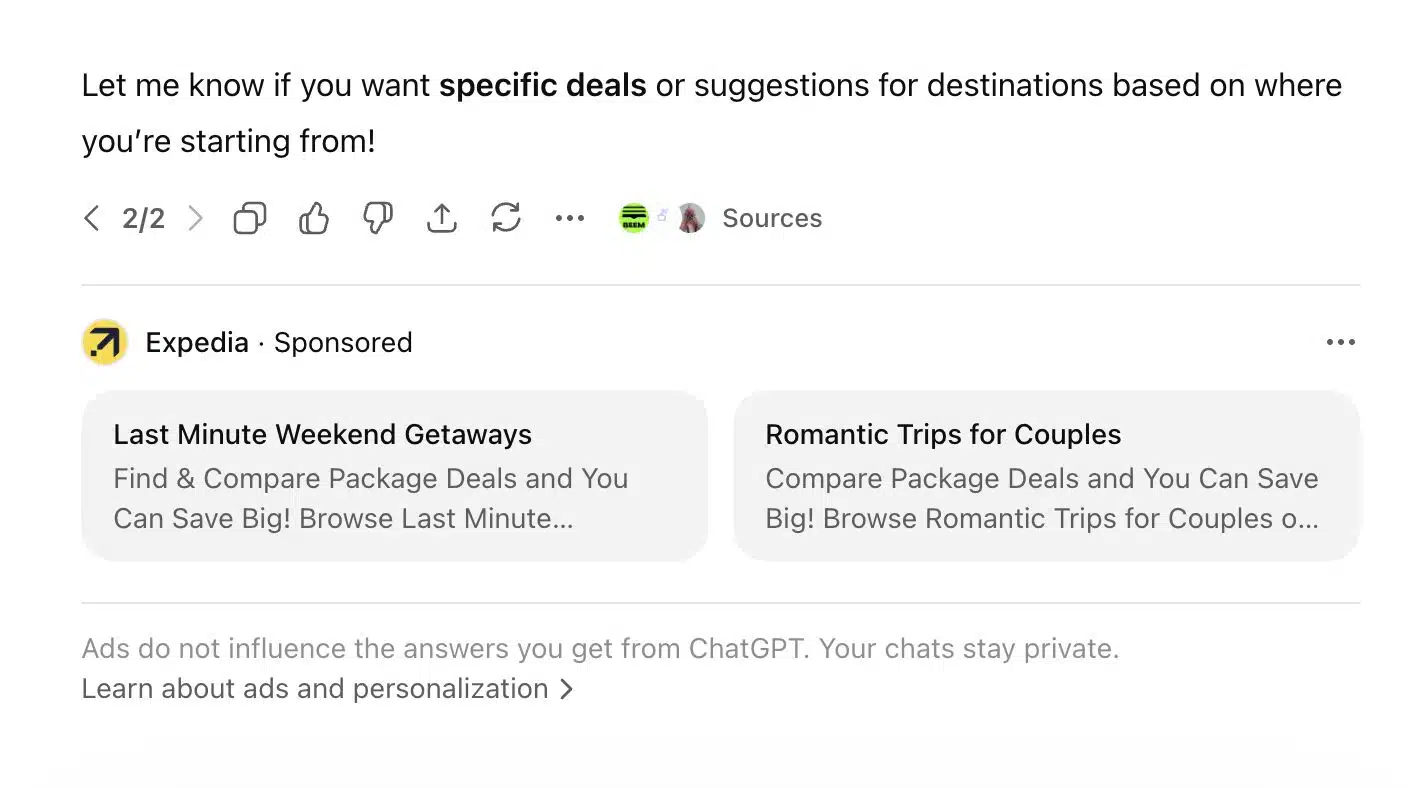
We don't know the exact UI yet, but the code, public comments, and competitive landscape point to:

1. Sponsored Recommendations Inside Answers

Contextual lines inside the response itself, for example:

"To manage X, tools like Brand A and Brand B are common. Brand A (Sponsored) integrates with your current stack…"

This is the most sensitive format because it sits directly inside the answer you came for.

2. Carousels When Prompts Look Like Product Research

A horizontal strip of options that appears when the model is clearly helping you discover or compare products or vendors, similar to a Google Shopping carousel but driven by conversational context.

3. Sponsored GPTs and Actions

Promoted agents and actions surfaced when you try to complete a task:

"Generate this campaign plan with [Brand GPT] - Sponsored."

This is distribution for agents paid for like ads.

4. Sponsored Options Inside In-Chat Shopping

When you already use ChatGPT as a shopping interface, some recommended merchants, bundles, or upgrades will almost certainly be paid placements over time.

5. Session or Feature Unlocks

Free-tier users watching or interacting with an ad to unlock longer sessions, extra context window, or paid tools like Deep Research without a subscription. Think "Spotify for tokens."

All of this runs on semantic intent matching (full conversation context), plus optional memory-based personalization for users who keep memory turned on.

Takeaway: Ads will be integrated into the conversation flow, not separated from it.

What This Means for Acquisition, Measurement, and AEO

What changes for your growth engine once ChatGPT ads and the wider "answer layer" become real channels?

Acquisition: A New High-Intent Surface

ChatGPT won't replace Google or Meta, but it will:

  • Capture a share of early research and vendor shortlist work
  • Handle more "what should I do next" type questions that used to go to blogs, docs, and communities
  • Blend product education, comparison, and activation in a single flow

For performance teams:

  • You'll get a new line item in the media mix that behaves like search, social, and marketplaces all at once.
  • Budget will flow to brands that are easy to explain, easy to compare, and easy to recommend.
  • If your positioning is vague and your product is hard to summarize, you'll pay for that.

Measurement: Attribution Gets Even Messier

Attribution in AI interfaces will likely be worse than what you're used to in search and social:

  • Less focus on clicks out to your site, more on in-chat actions
  • More session-level tokens and APIs, less cookie-based tracking

This makes these more valuable:

  • Clean analytics and data warehouses
  • Clear event and revenue definitions
  • Lift tests and incrementality over last-click models

If you don't have a solid measurement layer, fix it now. My Growth Architecture Playbook 2026 covers measurement that survives new channels and surfaces.

Ready to prepare your growth stack for ChatGPT ads?

I help teams map AI intent, fix measurement infrastructure, and build AEO-optimized content. Book a strategy session to assess how ChatGPT ads fit into your acquisition mix.

AEO: Being Recommendable by AI

If the "answer layer" is where more decisions happen, you want to show up there even when you're not paying. That's Answer Engine Optimization:

  • Clear entities for your brand, products, and key use cases
  • Structured data and clean schema
  • Documentation and content that models can easily quote and summarize
  • Honest explanations of when you're not the right fit

My AEO Growth Playbook 2025 covers how to structure content for AI interfaces and capture organic visibility.

Takeaway: This becomes a high-intent, high-trust performance channel that will punish weak positioning, sloppy measurement, and bad AEO.

How to Respond (Without Overreacting)

You can't buy ChatGPT ads at scale yet, but you don't need to wait. Start here:

Map Your "AI Intent Surface"

List 10 to 20 high-value questions where your ICP already uses tools like ChatGPT or Perplexity instead of Google. Capture the actual prompts, not just vague topics.

Stress Test Your Positioning and Content

Ask: if a model had to explain what we do in three sentences and compare us with two competitors, would it have enough raw material to do a good job?

Get Your Measurement and Data Into a Decent State

Before a new channel appears, fix the boring stuff: events, naming conventions, revenue mapping, basic lift testing.

You don't need a 50-page AI ad strategy slide deck. You need a realistic sense of where this can matter for your funnel and a growth stack that can absorb one more performance channel without breaking.

If you want to pressure test how this fits into your acquisition stack or AEO roadmap, I work on this with clients in my Audit and Strategy Sprint and Ongoing Growth Partnership.

Takeaway: Prepare by mapping AI intent, fixing measurement, and optimizing for AEO—not by building elaborate strategies for a channel that doesn't exist yet.

My Stance

Ads inside ChatGPT aren't automatically bad.

The real risk isn't the existence of ads but how tightly they're allowed to influence the model's behavior.

If sponsored content is clearly labeled, held to a high quality bar, and constrained by strong trust rules, most users will accept it.

If people ever feel the model is pushing worse options because someone paid, the core asset—trust—gets damaged fast and the ad product collapses with it.

For founders, CMOs, and growth leads, the interesting question is no longer "will there be ChatGPT ads?" The macro and product signals already answered that.

The real question is: who will treat ChatGPT as its own performance channel—with strategy, creative, measurement, and AEO designed for conversational, multi-step intent—instead of trying to copy-paste Google or Meta playbooks into a chat window?

Takeaway: The channel is coming. The question is whether you'll treat it as its own thing or try to force-fit old playbooks.

Author

Maciej Turek - Growth and Performance Marketing consultant

Maciej Turek

Growth and performance marketing consultant with 10+ years of experience implementing data-driven budget optimization, attribution frameworks, CRM systems, and growth strategies for EU startups and scale-ups. Specialized in Answer-Engine Optimization (AEO), performance marketing strategy, and measurement architecture. Former Growth Lead at bunq (€1.7B valuation fintech), Bitvavo (leading crypto exchange), and Resumedia. Has built budget allocation frameworks managing €50M+ in annual marketing spend and scaled growth funnels with proven expertise in CAC optimization, ROAS modeling, and multi-channel attribution.

Published: January 2026

Last updated: January 15, 2026

Ready to Prepare for ChatGPT Ads?

If you want to pressure test how ChatGPT ads fit into your acquisition stack or build an AEO roadmap, I work on this with clients.

Audit & Strategy Sprint → Ongoing Growth Partnership →

Both engagements include AI intent mapping, measurement architecture, and AEO optimization.